AI Automation & AI Product Builder
ZerotoShipped
I turn ideas and business problems into working systems, including products, automations and AI tools, built end-to-end and shipped.
How I Think
I look at how a process works, where things get stuck, and what a better solution needs to do. Then I bring together software, integrations, automation and AI where they make sense, with reliability and human oversight built into the design.
Selected Work
A curated set of products and systems I've taken from problem to shipped.
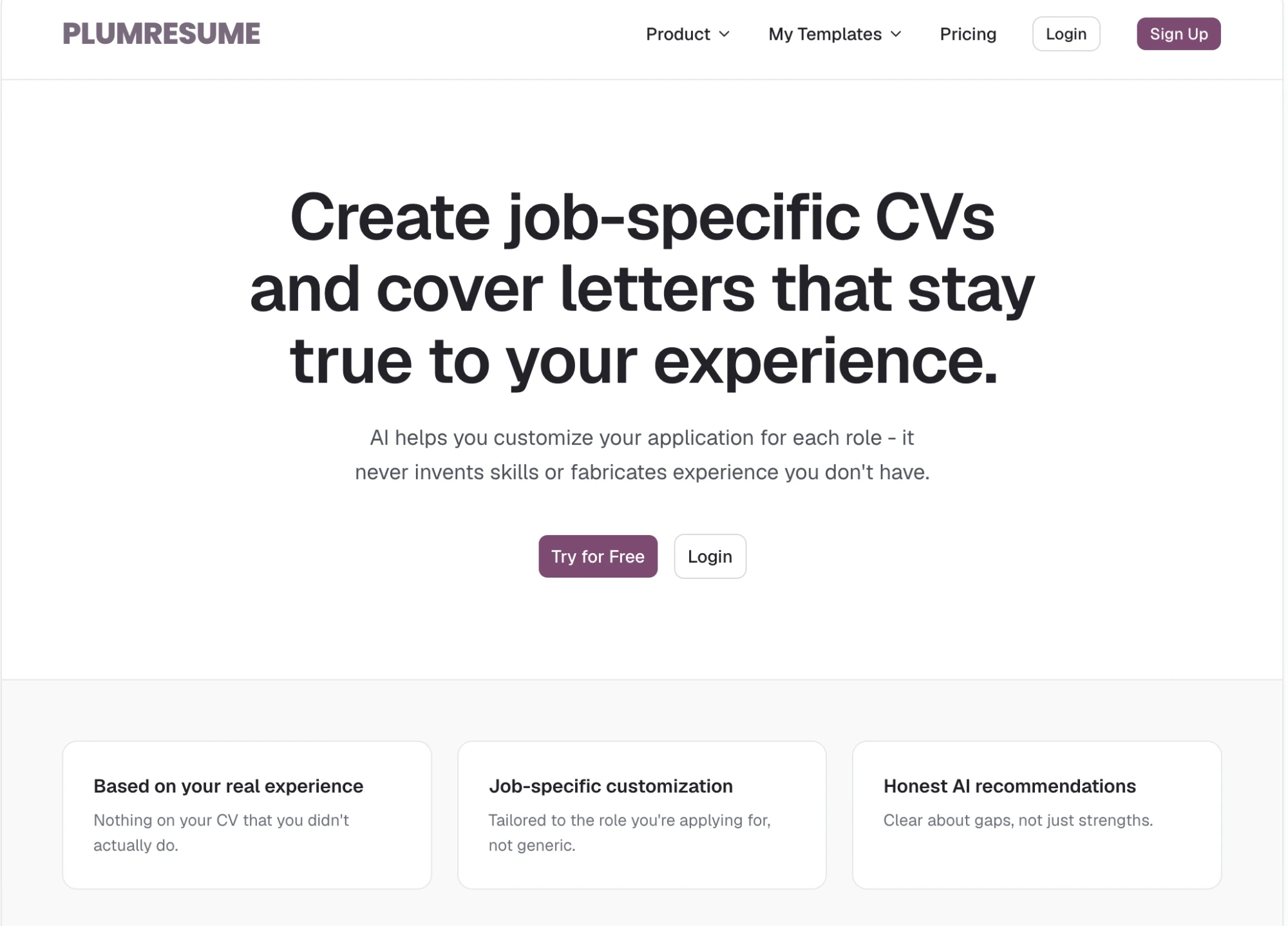
PlumResume
An AI product that helps job seekers tailor their CV and cover letter to a specific role, without inventing experience they don't have.
- Next.js
- TypeScript
- Tailwind CSS
- Supabase
- Postgres
- Anthropic API
- Vercel
The problem
Tailoring a CV and cover letter to each job posting is repetitive, so most people reuse one generic version or spend hours rewriting it by hand. Generic AI writing tools speed this up, but they often invent skills or experience the applicant doesn't actually have, right when credibility matters most.
What I built
PlumResume takes a job description and a candidate's real background, then generates a tailored CV and cover letter built on a "truthful AI" principle: it can improve how existing experience is presented, but it never invents history that isn't there. I owned the full process end to end, from validating the problem and defining the product, through UX, the AI layer, engineering, and deployment.
Business value
Designed to reduce the repetitive work of tailoring application materials for every role, while keeping the candidate's real experience, not invented experience, at the center of the result.
ProspectForge
A B2B outbound prospecting pipeline that turns an ideal-customer profile into a ranked, evidence-backed list of real companies and contacts.
Workflow
- Python
- FastAPI
- PostgreSQL
- Anthropic API
- Apollo.io
- HubSpot
The problem
Sales teams need qualified companies and contacts that fit their target market. Finding, researching, and verifying them manually takes time, while generic prospecting lists often leave reps doing the verification themselves.
What I built
A pipeline that takes an ideal-customer profile through discovery, enrichment, AI-assisted research, and decision-maker discovery, then runs every company through a deterministic qualification check before a person reviews and approves it into the CRM. Every stage isolates its own failures with retries and circuit-breaking, and the CRM sync is idempotent, so a retried run never pushes the same prospect twice.
Business value
Designed to reduce the manual research behind building a prospect list, make qualification decisions consistent rather than ad hoc, and give reps an evidence-backed, auditable handoff into the CRM, while keeping a person in control of which prospects actually get approved.
Speed-to-Lead
An automated lead capture and response system that gets a new website lead into the CRM, notifies the team, and sends an acknowledgement, without manual handling.
Workflow
- FastAPI
- PostgreSQL
- HubSpot
- Slack
- Resend
The problem
A new website lead is a potential sale, but only if someone acts on it. If it sits in an inbox or a disconnected form submission while someone manually enters it, the response can be slow or inconsistent, and leads can fall through the cracks.
What I built
Validates an incoming lead and checks whether it's already been processed, idempotent, so a retry or duplicate submission never creates a second record, then pushes it to the CRM, notifies the team, and sends an acknowledgement. The last three steps run independently with automatic retry on a backoff schedule, and anything that still fails is flagged for a person instead of silently dropped.
Business value
Designed to make the first handling of an inbound lead consistent and automatic instead of dependent on someone noticing it, reduce duplicate and dropped leads, and make any processing failure visible rather than silent.
Follow the Lead
Takes a CRM-qualified lead through a personalized, multi-step outreach cadence, handling replies and handoffs automatically.
Workflow
- FastAPI
- PostgreSQL
- Anthropic API
- Postmark
- Slack
The problem
Once a lead is qualified, sales teams usually need to follow up several times before getting a response. Tracking who's due for which follow-up across many leads at once is tedious by hand, and leads quietly go cold when that tracking slips.
What I built
Enrolls a qualified lead into a scheduled, multi-step outreach cadence and sends each step at the right time. Replies are classified deterministically first (unsubscribe, auto-reply, bounce), with an LLM used only for genuinely ambiguous cases, and every state change uses an optimistic-lock safeguard so a reply arriving the same moment as a scheduled send can't corrupt the lead's state.
Business value
Designed to keep a cadence running consistently per lead without manual tracking, while routing anything ambiguous to a person rather than guessing.
Extract to Act
Turns an invoice, in whatever format it arrives, into a structured, validated record and carries it through approval to a downstream accounting system.
Workflow
- FastAPI
- PostgreSQL
- Mistral OCR
- Docker
The problem
Businesses receive invoices in many formats, and pulling out the details, then checking they're complete and consistent, is repetitive manual work. That gets riskier with AI involved: an extracted number that's wrong and goes unnoticed can turn into an actual financial decision.
What I built
AI extracts structured data from an uploaded invoice; deterministic checks then validate it (arithmetic, required fields, vendor match, duplicate detection) before anything moves forward. Anything that fails a check is queued for a person to review next to the original document, and only validated, approved records post downstream, each with a full audit trail.
Business value
Intended to let confident extractions move straight through while keeping a probabilistic step from ever making a financial decision on its own.
Appointment Lifecycle Automation
An AI-assisted booking system that turns a customer's plain-language request into a confirmed appointment, while keeping the scheduling decisions themselves in reliable, rule-based logic.
Workflow
- FastAPI
- PostgreSQL
- Next.js
- Anthropic API
- Resend
The problem
Appointment scheduling looks simple until customers request overlapping times, cancellations happen, and reminders need to go out reliably. Handling that by hand, or trusting it entirely to an AI model, risks double-bookings, missed reminders, and no clear record of what happened.
What I built
AI reads a customer's plain-language request and turns it into a structured booking intent; application logic, not the AI, then owns actual availability and booking, using a database exclusion constraint to prevent conflicting bookings even under concurrent requests. Background jobs handle reminders, no-show detection, and recovery, and anything the system can't safely resolve escalates to a person.
Business value
Designed to handle natural-language booking requests without manual scheduling work, keep availability reliable under real concurrent demand, and automate reminders and no-show recovery while keeping a person in the loop for anything uncertain.
VoC / Review Manager
Turns scattered customer reviews for a multi-location business into prioritized, evidence-backed operational insights.
Workflow
- FastAPI
- PostgreSQL
- Anthropic API
- Next.js
- Recharts
The problem
A business with many locations can accumulate thousands of customer reviews. Spotting a recurring complaint or a pattern building over weeks is hard to do by reading reviews one at a time, so the signal that matters most is also the easiest to miss.
What I built
Classifies incoming reviews by topic, sentiment, and severity, rolls them up into recurring issues on a deterministic schedule, and generates a grounded insight and recommended action for each one, constrained to the evidence that actually supports it. A person approves the action before anything happens, and the system supports tracking whether the issue improves after an approved action.
Business value
Intended to turn individual feedback into a prioritized, explainable action list an operator can actually act on, without the AI ever acting on its own.
RAG Knowledge Assistant
An AI assistant that answers questions from an organization's own documents, with every citation checked against the actual source text instead of taken on faith.
Workflow
- FastAPI
- PostgreSQL
- pgvector
- OpenAI
- Ollama
- Langfuse
The problem
Important information is often spread across internal documents, manuals, and policies. A generic AI chatbot can answer questions about them, but it can't prove the answer actually came from that material rather than a confident-sounding guess, which makes it hard to trust for anything that matters.
What I built
The system retrieves the most relevant passages, optionally reranks them locally for accuracy, generates an answer grounded in that retrieved context, and validates every citation the model emits against the context actually sent, dropping anything that doesn't hold up. Retrieval and answer quality are measured against a hand-written evaluation set rather than assumed, every request is traced end to end, and sensitive documents can be routed to an on-device model instead of a third-party API.
Business value
Designed to make answer trustworthiness measurable and verifiable rather than assumed, including routing sensitive documents to an on-device model instead of a third-party API.
OpsPilot
An AI assistant for production incidents that investigates and proposes a fix, while a separate policy layer decides whether that fix is actually allowed to run.
Workflow
- FastAPI
- PostgreSQL
- LangGraph
- Anthropic API
- Langfuse
- Next.js
The problem
Production incidents require investigation and remediation, but letting an AI model execute a fix on its own introduces real safety risk. A plausible-sounding diagnosis is not the same thing as an action that's actually safe to run unattended.
What I built
The agent investigates using read-only tools across logs, metrics, and deployment history, then proposes a diagnosis and remediation. A deterministic policy layer, keyed only on action type and never the model's stated confidence, decides whether that action executes automatically, requires human approval, is blocked outright, or escalates, and the whole process is checkpointed so a crash mid-approval resumes exactly where it stopped instead of risking a duplicate execution.
Business value
Designed to reduce the manual investigation burden during an incident, create a controlled path toward AI-assisted operations, and keep the model from ever independently deciding which production actions are safe, with every decision auditable afterward.
Vendor Due Diligence
A vendor evidence review system built to test whether splitting that review across independent AI investigators improves verification quality over a single strong reviewer.
Workflow
- Python
- FastAPI
- PostgreSQL
- Anthropic API
The problem
Approving a vendor often means reviewing evidence across security, privacy, and AI-governance documentation, each needing different scrutiny, in a way that stays consistent. It's tempting to assume that adding more specialized AI reviewers automatically makes that review more thorough, but that's an assumption this project treats as a question worth testing.
What I built
Two domain-specific AI investigators, one for security and one for privacy and AI governance, review the same evidence independently, with context boundaries enforced at the data-access level rather than by instruction. Findings are reconciled deterministically first; only genuine conflicts escalate to a second, bounded round of AI adjudication, and a person always makes the final call. The independent-investigator approach is evaluated against a single strong AI reviewer using a pre-registered methodology, decided before the test ran, not adjusted afterward to fit the result.
Business value
Intended to make vendor evidence review more structured and auditable, turn the cost of added AI complexity into something measurable instead of assumed, and keep the final vendor decision in human hands regardless of what the AI investigators conclude.
How I Work
Start with the actual problem, not the AI feature. Understand the workflow before touching the stack.
About

- Focus
- AI Product Building, Workflow Automation, Business Systems
- Background
- Information Technology, International Management, Business Development, Marketing and Operations
- Tools & Technologies
- Claude Code, n8n, Make, Python, APIs, LLM Applications, HubSpot, Apollo, Airtable, Notion, Slack, Power Automate, Zapier, Resend, Mistral OCR, Postmark, LangGraph, Langfuse
- Location
- Berlin, Germany
I like working at the point where business problems meet technology: understanding what needs to work better, then building something that helps make it happen.
I studied Information Technology and later International Management, then worked across business development, marketing and operations. Those experiences taught me to look at problems from both sides: the outcome a business needs and the processes, tools and coordination required to get there.
Over time, I wanted to do more than identify problems or suggest improvements. I wanted to build the solutions myself.
That now means building AI-powered products and automations, from defining the problem and shaping the experience to implementing the underlying systems and deploying them.
I work across product thinking, workflow design and hands-on implementation. I use software, integrations and AI where they solve a real problem, and pay attention to what happens beyond the happy path: errors, edge cases and the points where human judgment matters.
Contact
Have a problemworth building?
If you're building a team, improving a process, or exploring an idea, I'd be glad to connect.

Privacy & data protection
This site doesn't collect, store, or transmit any personal data. There are no forms, no accounts, and no analytics or tracking scripts. The only thing saved is your language preference, kept in your browser's local storage and never sent anywhere. The LinkedIn and GitHub links on this page lead to third-party sites with their own privacy policies.
Cookies
This site does not use cookies. Your language preference is stored in your browser's local storage, not a cookie. It's purely functional, so there's nothing to ask your consent for.
GDPR
Since no personal data is collected, stored, or processed by this site, there's no data to access, correct, or delete under the GDPR or similar regulations. For any privacy question, reach out via LinkedIn.